About Social Work
Social work is “a profession devoted to helping people function the best they can in their environment” by providing individuals with the necessary tools and resources to “cope with problems in their everyday lives.” Learn more about the profession from the Council on Social Work Education.
The three types of social work practices are: Micro-level practice (social workers work directly with clients and help them cope with particular situations), Mezzo-level practice (social workers work with groups of people rather than with a single person), and Macro-level practice (social workers establish social change on a larger scale which is achieved by organizing, establishing policy change, or serving an administrative role).
Social workers are found in every facet of community life, including schools, hospitals, mental health clinics, senior centers, elected offices, private practices, prisons, military, corporations, and in numerous public and private agencies.
For the most up-to-date salary information, visit the U.S. Bureau of Labor Statistics website.
Note: In addition to the resources below, we suggest connecting directly with staff at UW-Madison’s Social Work program. We also encourage you to reach out to a Career Advisor in your school/college for additional assistance. For example, students in the College of Letters & Science can see career & internship specialist Maureen Muldoon at SuccessWorks for more about social work and preparing for graduate school and job applications. While this field is not among CPHA’s primary areas of advising expertise, we are here to support you in exploring the career, building helpful experiences, and navigating some aspects of professional program applications. Talk with us if you have questions!
Degree/Certification Paths
This is an accordion element with a series of buttons that open and close related content panels.
Bachelor of Social Work (BSW)
A bachelor’s degree in social work (BSW) is required for any entry level position. Roles might include direct case management with clients as a generalist. Additionally, if you go on to earn your MSW, it may shorten time to degree.
Master of Social Work (MSW)
Master’s programs are typically two years in length and include coursework and field placement components. Licensing requirements vary by state, and more information can be found on the Association of Social Work Boards (ASWB) website.
Advanced Practice Specialty Credentials
Some social workers will seek additional training and become licensed in areas such as case management, education, gerontology, healthcare, hospice, mental health, substance abuse, or youth/family.
In order to provide mental health services, a social worker can become a licensed clinical social worker (LCSW). To do this, a person must get a master of social work (MSW), complete two years of post-master’s experience in a supervised clinical setting, and be licensed in the state in which they practice.
Doctorate of Social Work (PhD or DSW)
The Doctorate of Social Work allows you to take a deep dive into an issue and become an expert! The Doctor of Social Work (DSW) degree is a practice doctorate while the Doctor of Philosophy (PhD) prepares graduates for roles in academia or research.
Explore Your Interest in Social Work
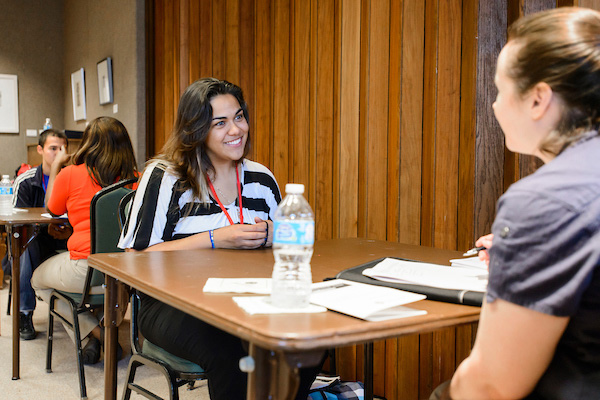
Shadowing & Informational Interviews
An excellent way to explore your interest in the profession is by talking directly with social workers. If you have friends or family who work in healthcare or human services (in ANY role) ask if they know anyone in social work and arrange a Zoom chat. Look for social workers on LinkedIn, Instagram, or TikTok and see if they are willing to talk about their career.

Volunteering
Social work programs look for applicants who demonstrate a sustained commitment to serving others. Learn more about opportunities to volunteer in clinical and non-clinical settings.

Jobs
After volunteering and exploring, getting a job in settings where you’d work alongside social workers is a great way to learn about practical aspects of the field.
Additional Exploration Resources
National Association of Social Workers (NASW) Social Work Talks Podcast
Finding a Program
BSW / MSW: Council on Social Work Education (CSWE) Bachelor’s and Master’s Program Directory
DSW / PhD: Group for the Advancement of Doctoral Education in Social Work (GADE) DSW and PhD Program Directory
Learn more about UW-Madison’s BSW program and MSW program. Reach out to website@socwork.wisc.edu with questions or to get connected to a current student. Register for an upcoming MSW Program information session.
Educational & Professional Assocations
- Association of Social Work Boards (ASWB)
- Council on Social Work Education (CSWE)
- Group for the Advancement of Doctoral Education in Social Work (GADE)
- National Association of Black Social Workers (NABSW)
- National Association of Social Workers (NASW)
- School Social Work Association of America (SSWAA)
- Society for Social Work and Research (SSWR)
Preparing for a Social Work Program
Requirements vary from school to school, so it’s always necessary to consult program websites. Find a list of programs via the link above.
MSW applicants can have any undergraduate major combined with pre-requisite coursework. Common pre-reqs include psychology, statistics, biology, sociology, economics, or political science.
Some programs require the Graduate Record Exam (GRE). The module “Prepare for the GRE” on our “Applying to Health Professions” Canvas course has more information on study plans, resources, and tips for the GRE.
Application Process
Some accredited Social Work programs use SocialWorkCAS as a common application. Others will have you apply directly on their website.
The SocialWorkCAS Help Center shares more information about application components.
Reach out to schools directly to request a fee waiver if application costs make applying prohibitive.
Some programs require the Graduate Record Exam (GRE). The module “Prepare for the GRE” on our “Applying to Health Professions” Canvas course has more information on study plans, resources, and tips for the GRE.
The Council on Social Work Education (CSWE) maintains a list of funding opportunities and more information about “How do I pay for school?”
Enroll in Applying to Health Programs
CPHA runs a Canvas course called Applying to Health Programs, a non-credit course designed to help you with the process of applying to programs like social work programs.